Budget-Friendly Science Supplies Every Homeschool Should Have
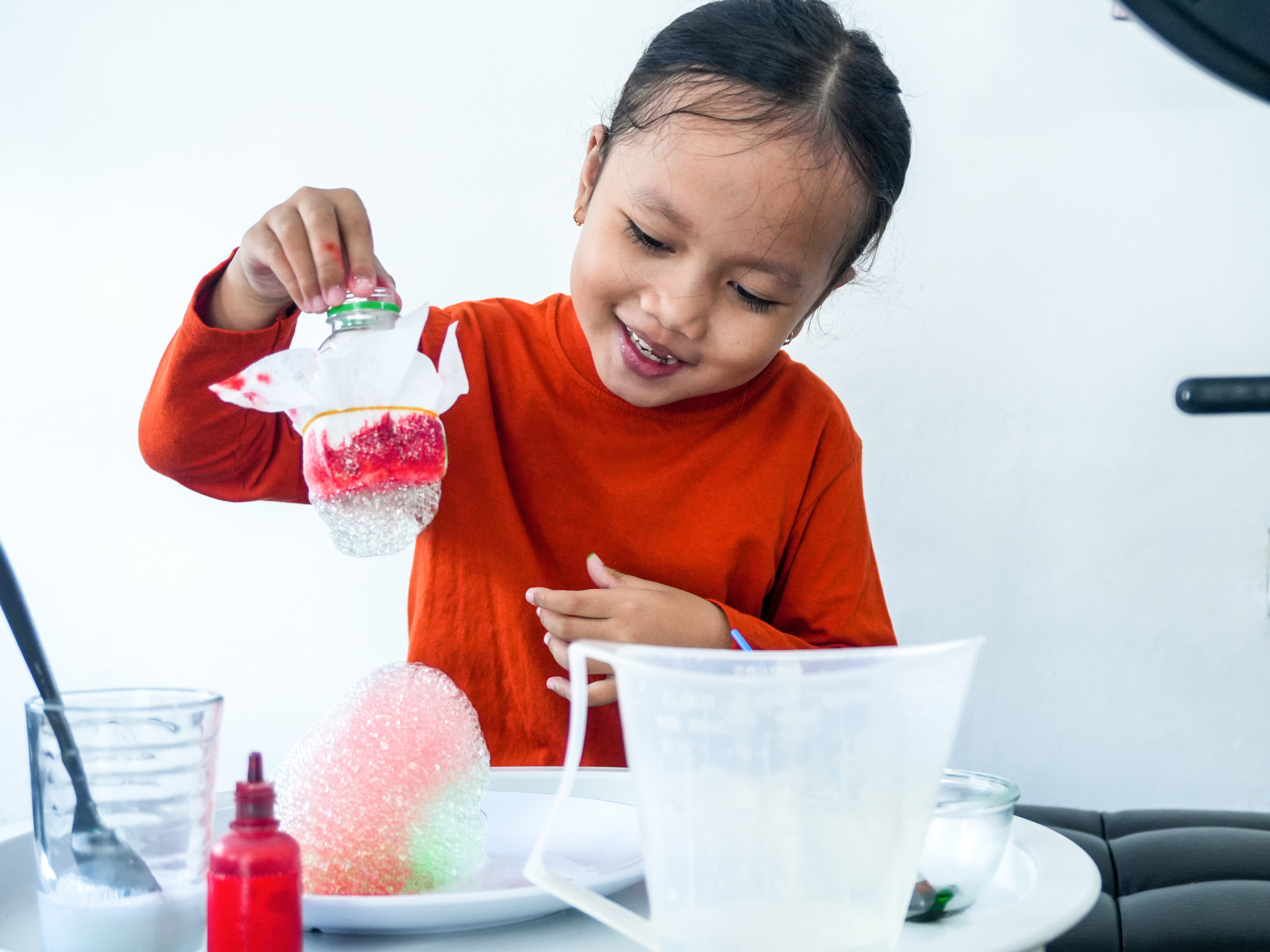
Do you need a closet full of expensive science equipment to teach science at home?
Absolutely not!
If you're homeschooling a kindergartener, first grader, or second grader, you might be surprised by how much science you can explore with things you already have in your kitchen, craft supplies, or junk drawer.
Young children don't need a fancy laboratory to become scientists. They need opportunities to observe, ask questions, make predictions, test ideas, and discover how the world works.
And the good news?
You can build a fantastic collection of homeschool science supplies without spending a fortune.
In fact, some of the most useful science supplies are probably already hiding in your house.
What Supplies Do You Really Need for Homeschool Science?
When you're teaching science to young children, it's easy to get overwhelmed by all of the science kits, lab equipment, and specialty supplies available online.
But before you buy a microscope, a chemistry set, or a giant experiment kit, start with the basics.
For K-2 science, I recommend building a small collection of inexpensive, reusable supplies that can be used for lots of different investigations.
Here are some of my favorite budget-friendly science supplies for homeschool families.
1. Clear Plastic Cups
Clear cups are one of those supplies that seem incredibly simple—until you realize how many science activities you can use them for!
They're great for:
Mixing and comparing liquids
Observing seeds as they grow
Exploring sinking and floating
Making simple density investigations
Watching ice melt
Creating color-mixing activities
Observing changes over time
Plastic cups are especially useful for young scientists because children can easily see what's happening inside.
You don't need laboratory beakers when a clear cup will do the job!
2. Measuring Cups and Spoons
If you already have measuring cups and spoons in your kitchen, congratulations—you already have science equipment!
Measuring is an important part of scientific investigations, and young children can practice measurement while exploring all kinds of questions.
Try asking:
What happens if we use more water?
Which container holds more?
How much baking soda do we need?
Does changing the amount change what happens?
You can use measuring cups and spoons for experiments involving water, baking soda, vinegar, seeds, soil, and so much more.
Plus, they're reusable for everyday life when science time is over.
3. Droppers or Pipettes
A package of inexpensive plastic droppers is one of my favorite additions to a homeschool science supply box.
Children LOVE using droppers.
They also provide a wonderful opportunity to practice careful observation and fine-motor skills while doing science.
Droppers can be used for:
Color mixing
Moving water between containers
Exploring absorption
Adding liquids one drop at a time
Simple chemical-reaction demonstrations
Investigating how different materials interact with water
You don't need dozens. A small package can last through many science activities.
4. Magnifying Glasses
You don't need a microscope to start exploring the tiny details of the world around you.
A simple magnifying glass can turn an ordinary walk outside into a science adventure.
Take your magnifying glass outdoors and look closely at:
Leaves
Rocks
Tree bark
Flowers
Insects
Seeds
Feathers
Soil
Ask your child:
What do you notice?
Does it look different when you make it bigger?
What details can you see that you couldn't see before?
This is a great way to introduce children to one of the most important scientific skills: observation.
5. Baking Soda and Vinegar
If you're putting together a budget-friendly homeschool science supply box, baking soda and vinegar deserve a spot on the list.
These inexpensive kitchen staples can be used for many hands-on investigations.
You can explore questions about:
Chemical reactions
Bubbles and gas
What happens when substances are combined
Making predictions
Changing the amount of a material and observing the result
And yes, you can make a baking soda volcano!
But don't stop there.
Instead of simply showing your child what happens, turn the activity into an investigation.
Ask:
What do you think will happen?
What happens if we use more baking soda?
What happens if we use less vinegar?
Does changing one thing change the reaction?
That simple shift turns a fun demonstration into an opportunity for scientific thinking.
Remember that all science activities involving household materials should be age-appropriate and completed with appropriate adult supervision.
6. Food Coloring
A few drops of food coloring can make invisible processes much easier for young children to see.
Food coloring is useful for exploring:
Color mixing
Water movement
Absorption
Plant investigations
Simple liquid experiments
It's also inexpensive and lasts a long time because you usually only need a few drops at a time.
Try putting different colors into cups of water and asking your child:
What happens when we mix red and blue?
What color do you predict we'll make?
What happens when water moves from one cup to another?
Science doesn't have to be complicated to be fascinating.
7. Balloons
Keep a package of balloons in your science supply bin.
They're inexpensive, easy to store, and surprisingly useful for hands-on science.
Balloons can help children explore ideas like:
Air
Forces
Motion
Static electricity
Cause and effect
You can even use a balloon to investigate static electricity by rubbing it against hair or fabric and then seeing what happens when you bring it near small pieces of paper.
The best part?
Your child will probably think they're playing.
That's okay.
Science and play can absolutely happen at the same time.
8. String
String is another inexpensive supply that can be used in all kinds of investigations.
Use it for:
Measuring
Building simple structures
Exploring movement
Creating pulley investigations
Making comparisons
Building STEM challenges
You can even challenge your child to build something using string and a few other household materials.
Then ask:
What worked?
What didn't work?
What could we change?
That is engineering!
9. Magnets
A small set of child-friendly magnets can provide hours of exploration.
Give your child a collection of everyday objects and ask:
Which objects do you think the magnet will attract?
Let them make predictions before testing.
They can sort objects into groups such as:
Magnetic
and
Not Magnetic
Then ask them what the magnetic objects have in common.
Magnets are a wonderful example of how a simple object can lead to a much bigger scientific question.
10. Zip-Top Bags
Never underestimate the science potential of a zip-top bag!
They're useful for experiments involving:
Seeds
Water
Ice
Mixing
Observations over time
Simple plant-growth investigations
One of my favorite uses is growing a bean seed in a clear bag with a damp paper towel.
Your child can watch the seed change over several days and observe roots and shoots developing.
It's a great reminder that science doesn't always happen in five minutes.
Sometimes the best science happens when we slow down and observe something over time.
11. Paper Towels
Paper towels are another inexpensive supply that can be used again and again.
They're especially useful for exploring water movement and absorption.
Try comparing different types of paper towels.
Which one absorbs the most water?
Which one absorbs water the fastest?
What happens when you change the amount of water?
You can also use paper towels for seed-growing investigations, cleaning up experiment spills, and all kinds of simple STEM challenges.
12. Plastic or Glass Jars
Save a few clean jars from your recycling bin and add them to your science supplies.
Clear jars are wonderful because children can see what's happening inside.
Use them for:
Growing plants
Observing water
Collecting natural objects
Comparing materials
Simple density investigations
Nature observations
Before using recycled containers, make sure they are clean, safe, and appropriate for the activity.
13. Rulers and Measuring Tools
You don't need expensive laboratory measuring equipment to introduce children to scientific measurement.
A simple ruler can help your child investigate:
How tall a plant is
How far a toy travels
How long a shadow is
How objects compare in size
How something changes over time
Try measuring the same plant every few days.
Is it getting taller?
How much did it grow?
What do you predict it will measure next week?
Now you're combining science, math, observation, and prediction.
14. Paper, Pencils, and Crayons
These might be the most important science supplies of all.
Science isn't just about doing an experiment.
It's also about communicating what you observe.
A simple science notebook can give your child a place to:
Draw what they see
Record observations
Make predictions
Ask questions
Describe results
Draw pictures of an experiment
For young children who aren't writing independently yet, you can write down their words for them.
For example:
"I think the plant grew because it got water."
That's scientific thinking!
Their science notebook doesn't need to be perfect.
It doesn't need elaborate illustrations or pages of writing.
A few drawings and observations are enough to start.
15. A Simple Science Supply Bin
Once you've collected a few supplies, put everything into one container.
You don't need a dedicated science room.
You don't even need a huge cabinet.
A small plastic bin can become your family's Science Discovery Box.
You might include:
Magnifying glasses
Droppers
Measuring cups and spoons
Plastic cups
Balloons
String
Magnets
Rulers
Zip-top bags
Paper towels
Food coloring
Baking soda
A notebook
Crayons or pencils
Then add supplies as you find them.
This makes science much easier to start because you don't have to hunt around the house every time you want to do an experiment.
What About Science Kits?
Science kits can be fun, but you don't need to buy a kit for every topic.
For K-2 learners, many investigations can be done with inexpensive household materials.
If you do decide to purchase a science kit, look for one that:
Is designed for your child's age
Includes clear instructions
Encourages hands-on investigation
Gives children opportunities to make observations and predictions
Can be used more than once
Think of a science kit as a supplement—not a requirement.
The goal isn't to own the most science supplies.
The goal is to give your child opportunities to do science.
You Probably Already Have More Science Supplies Than You Think
One of my favorite things about teaching science to young children is realizing how little you actually need.
A cup can become a science tool.
A paper towel can become a science tool.
A balloon can become a science tool.
A leaf from your backyard can become a science tool.
Science is all around us.
The National Science Teaching Association similarly recommends simple, hands-on activities using materials available at home and emphasizes skills such as questioning, observing, discussing, and reflecting.
You don't need a laboratory.
You need curiosity.
Start Small
If you're just beginning to build your homeschool science supplies, don't feel like you need to buy everything at once.
Start with a few basics:
Magnifying glass + clear cups + droppers + measuring tools + paper + a few kitchen staples
That's enough to get started with dozens of investigations.
Then pay attention to what your child enjoys.
Do they love plants?
Add seeds and gardening supplies.
Are they fascinated by bugs?
Add a bug viewer or nature guide.
Do they love building?
Add cardboard, tape, craft sticks, and recycled materials.
Let your child's questions guide what you add next.
The Most Important Science Supply? Curiosity.
It's easy to think that good science education requires expensive equipment.
But for young children, the most important thing you can provide isn't a piece of equipment.
It's an opportunity to wonder.
What do you think will happen?
Why do you think that happened?
What could we try next?
Those questions are more valuable than a shelf full of science kits.
Your child doesn't need to have a perfect experiment.
They don't need to get the "right" answer.
They need opportunities to explore, make predictions, notice patterns, and learn from what happens.
That's what science is all about.
So grab a few supplies from your kitchen, head outside, or open that recycling bin.
You might be surprised by how much science you can discover with the things you already have.
And who knows?
Your next great science experiment might be sitting in your junk drawer right now!
At Itsy Bitsy Scientist, our goal is to help families and educators bring hands-on science adventures to young learners through engaging stories, activities, and discoveries. Science doesn't have to be complicated or expensive. It just needs to give children a chance to explore, wonder, and see themselves as scientists.
Happy exploring, little scientists!
All activities require adult supervision.
