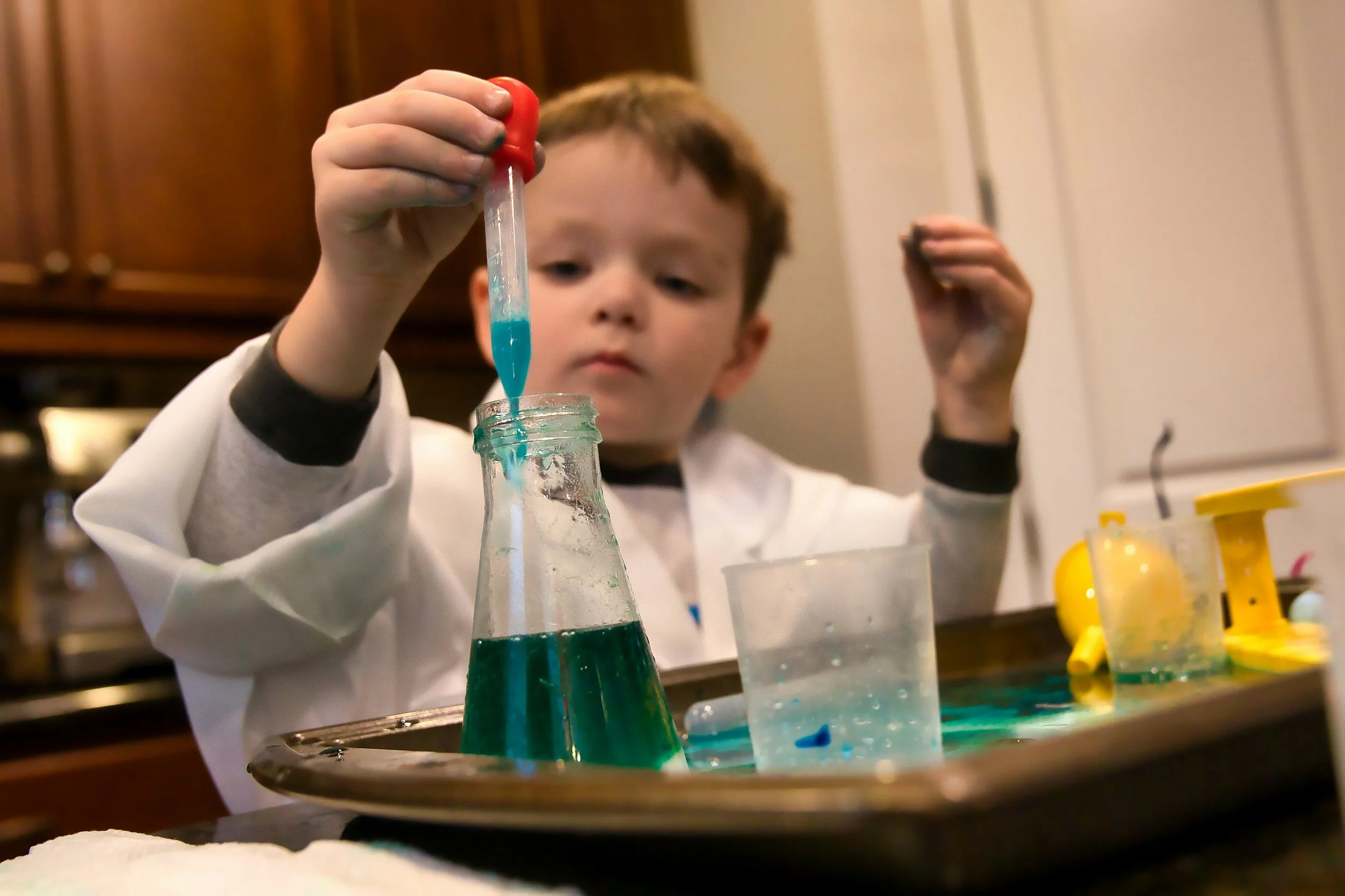
What happens when a child’s science experiment doesn’t work?
Maybe the baking soda and vinegar barely fizzed. Maybe the paper airplane flew in completely the wrong direction. Maybe the plant they were observing didn’t grow the way they expected.
You might hear:
“Something went wrong!”
But what if we changed the way we think about that moment?
Nothing went wrong. Your child just learned something.
One of the most important lessons we can teach young children about science is that mistakes, surprises, and unexpected results are not failures. They are part of the process. Scientists don't always know what will happen when they begin an experiment. They make predictions, test ideas, observe what happens, and sometimes discover that their original idea was wrong.
And that is exactly what makes science so exciting!
Science Isn't About Getting the "Right" Answer
When children are young, they can sometimes develop the idea that science is about knowing the correct answer.
What is this animal?
What planet is that?
Which object is heavier?
What happens when we mix these two things?
Those questions are great, but science is about much more than remembering facts.
Science is also about asking:
“I wonder what will happen if…?”
That question is where experimentation begins.
When a child makes a prediction and tests it, they're practicing a fundamental part of scientific thinking. They are using what they already know to make an educated guess, testing that idea, and then paying attention to the evidence.
Sometimes their prediction will be correct. Sometimes it won't. Both outcomes are valuable.
Let Kids Be Wrong
This can be surprisingly difficult for adults.
We naturally want to help children succeed. If we know what is going to happen during an activity, it can be tempting to steer a child toward the expected result.
But try resisting that urge.
If your child predicts that a wooden block will sink, you don't need to tell them, “Actually, wood floats.”
Let them test it.
If they predict that a plant will grow faster in a particular location, let them make the prediction.
If their paper airplane takes an unexpected dive instead of soaring across the room, that's okay too.
Instead of correcting the prediction before the experiment, ask:
“What do you think will happen?”
Then test it together.
Afterward, ask:
“What happened?”
And perhaps most importantly:
“Were you surprised?”
That conversation can be much more valuable than simply telling them the answer.
Turn "I Was Wrong" Into "I Learned Something"
Imagine your child predicts that a rock will float in water. They put it in the bowl and it sinks.
A child who thinks science is about being right might say: “I got it wrong.”
This is where adults have a wonderful opportunity to change the conversation.
You might say:
“Your prediction was different from what happened. That's interesting! What did we learn?”
Now the focus isn't on being right or wrong.
The focus is on evidence.
The child made a prediction.
They tested it.
They observed the result.
And now they have new information.
That is science.
Scientists Make Surprising Discoveries
As a PhD-trained scientist, one of the things I love about science is that the unexpected result isn't necessarily a problem.
Sometimes the unexpected result is the most interesting part.
Scientists can begin an experiment with a hypothesis and discover that the evidence doesn't support it. They may need to rethink their idea, change their experiment, or ask an entirely new question.
Young children can experience this same process on a much smaller scale.
You don't need a laboratory.
You don't need complicated equipment.
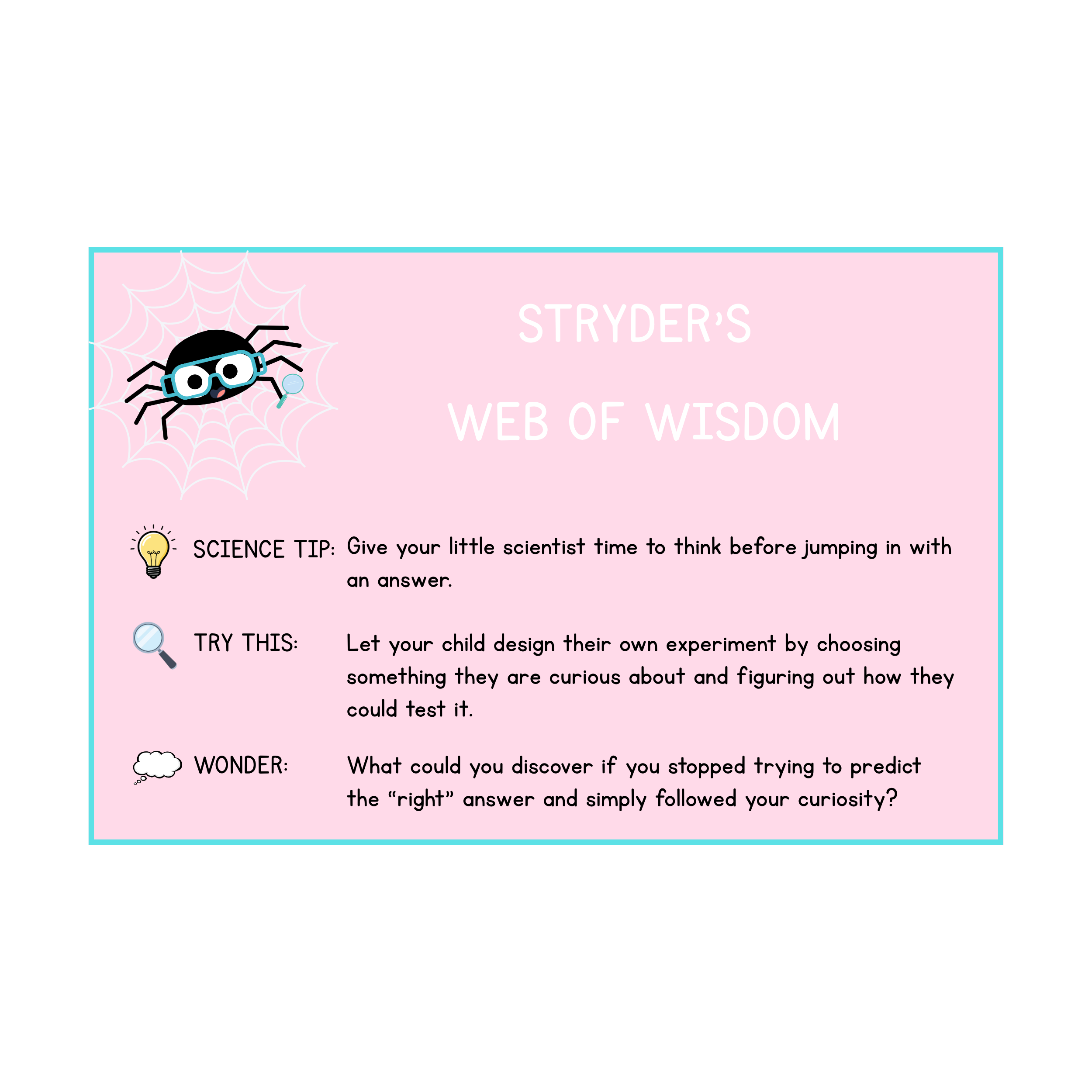
You simply need an opportunity for a child to wonder, predict, test, and observe.
5 Ways to Encourage Experimentation at Home or in the Classroom
1. Ask for predictions
Before starting an activity, pause and ask:
“What do you think will happen?”
“Which one do you think will happen first?”
“Which object do you think will go farther?”
“What do you think will happen if we change this?”
There doesn't need to be a correct prediction.
The goal is to get children thinking before they test their ideas.
2. Don't reveal the answer too soon
If you already know what will happen, try not to give away the result.
Instead of saying:
“That's going to sink.”
Try:
“Let's find out!”
You may already know the answer, but your child gets to discover it.
3. Celebrate unexpected results
When something doesn't happen the way you expected, don't immediately move on.
Say:
“Whoa! That wasn't what we expected.”
Then ask:
“Why do you think that happened?”
An unexpected result can become the beginning of a completely new investigation.
4. Change one thing
Once children are comfortable experimenting, encourage them to change one part of an activity and see what happens.
For example:
What happens if we use more water?
What happens if the ramp is steeper?
What happens if we put the object somewhere warmer?
What happens if we change the size of the paper airplane?
Changing one variable at a time helps children begin to understand that different conditions can produce different results.
5. Let children try again
Sometimes the best response to an unexpected result is simply:
“Let's try it again.”
Repeating an experiment gives children the opportunity to notice whether they get the same result or something different.
And if they get a different result?
Even better.
Now you have another question to investigate.
You Don't Need to Have All the Answers
One of my favorite things about doing science with young children is that adults don't have to be the expert in the room.
You can say:
“I don't know. Let's find out.”
That is a powerful scientific response.
You are showing children that not knowing something isn't embarrassing. It's an invitation to investigate.
You are also modeling something incredibly important: curiosity doesn't stop when you become an adult.
When children see adults wondering, questioning, testing, and changing their minds based on evidence, they begin to understand what science really looks like.
Give Children Permission to Wonder
As Thomas Edison once said, “I haven’t failed. I just found 10,000 ways that won’t work.”
The next time a science activity doesn't go according to plan, resist the urge to call it a failure. Instead, pause. Look at what happened. Ask questions. Make another prediction.Try again.
Because the goal of science for young children isn't to make sure every experiment produces the expected result.
It's to help them become comfortable with asking questions and curious enough to find out what happens next.
Mistakes aren't the opposite of science.
Mistakes are a part of science.
And when we give children permission to be wrong, change their minds, and try again, we're giving them something much more valuable than the "right" answer.
We're helping them learn to think like scientists.
About the Author: Nina is a PhD-trained scientist and the creator of Itsy Bitsy Scientist. After years of exploring the mysteries of science through research, she discovered that the most exciting part of science is the journey of discovery. She uses her scientific experience to create hands-on adventures that spark curiosity, inspire young minds, and help children see themselves as scientists.
