Easy Constellation Activities for Kids

Have you ever watched a child look up at the night sky and ask, "What's that?" Those little moments of wonder are exactly where science begins.
Constellations are one of the easiest ways to introduce young children to astronomy. They combine storytelling, observation, creativity, and early science skills in a way that feels like play. Best of all, you don't need expensive equipment or a telescope to get started.
Whether you're a homeschool parent, classroom teacher, or simply looking for a fun STEM activity, these easy constellation activities for kids will help spark curiosity about the universe.
What Are Constellations?
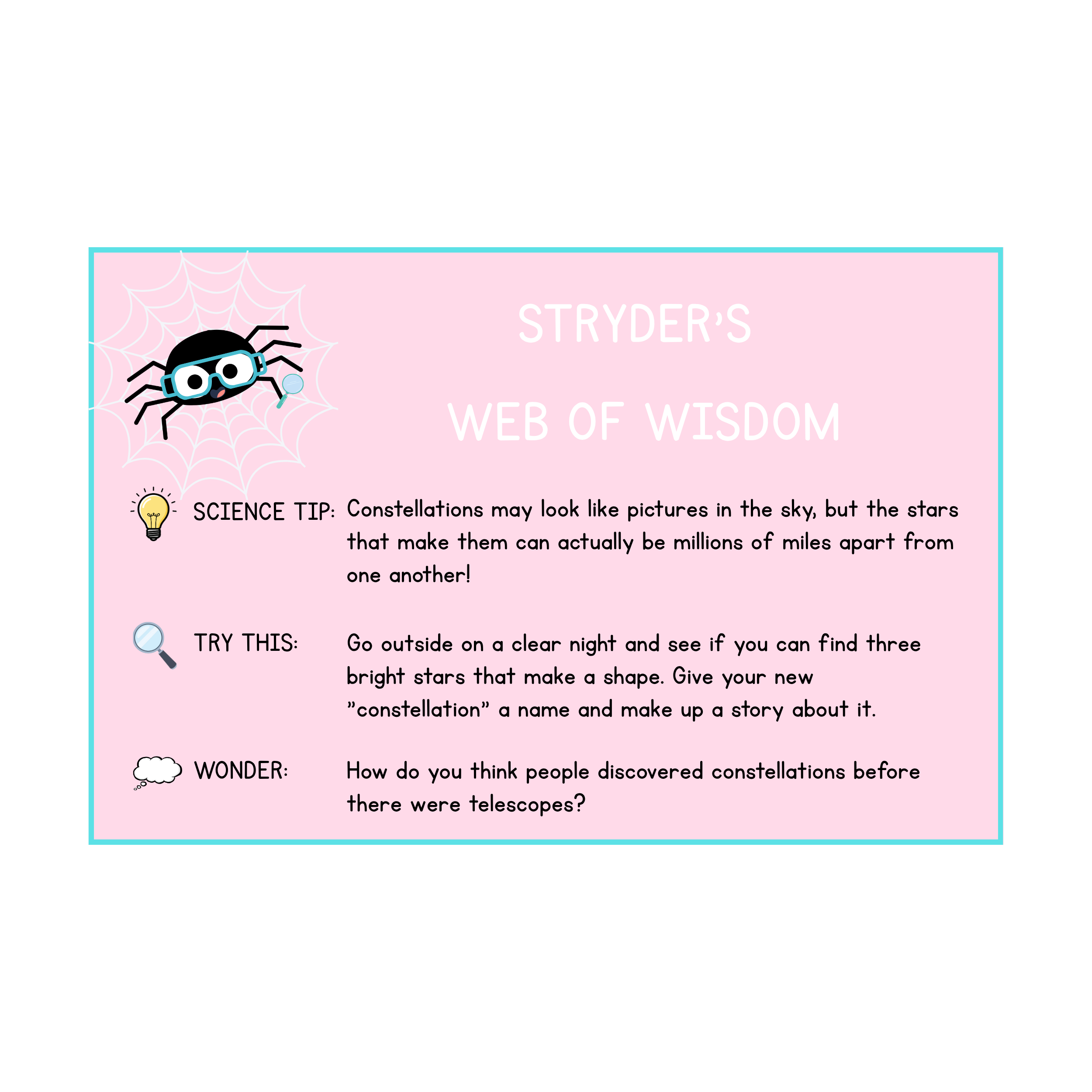
Constellations are groups of stars that people have connected into pictures for thousands of years. Different cultures created stories about these star patterns to explain the world around them, remember important events, or help travelers find their way.
Although the stars aren't actually connected, imagining shapes between them helps us identify different areas of the night sky.
For young children, constellations are a wonderful introduction to:
Astronomy
Observation skills
Pattern recognition
Storytelling
Scientific curiosity
1. Build a Marshmallow Constellation
This hands-on STEM activity lets children create their own star patterns.
You'll Need
Mini marshmallows
Toothpicks
Constellation picture cards (or draw your own)
What to Do
Children connect marshmallows with toothpicks to recreate simple constellations like the Big Dipper or Orion. Once they've built the pattern, encourage them to invent their own constellation and tell a story about it.
This activity strengthens fine motor skills while introducing the idea that constellations are simply patterns we recognize in the stars.
2. Create a Flashlight Constellation
Bring the night sky indoors!
You'll Need
Black construction paper
Push pin
Flashlight
Tape
What to Do
Poke holes into the paper to form a constellation. Tape the paper over the flashlight and shine it onto a wall in a dark room.
Children love seeing the "stars" appear, and it opens conversations about how stars are much farther away than they appear.
3. Make a Glow-in-the-Dark Star Ceiling
Turn your ceiling into a mini planetarium.
Use glow-in-the-dark stars to recreate a few simple constellations. As children lie on the floor, encourage them to look for patterns and identify familiar shapes.
Ask questions like:
Which stars seem close together?
Can you find a shape that looks like an animal?
What story would you make about these stars?
4. Dot Sticker Constellations
Perfect for preschoolers and kindergarteners.
Draw several constellation outlines on paper using small dots. Children place star stickers on each dot before connecting them with crayons or markers.
This activity practices:
Counting
One-to-one correspondence
Fine motor skills
Visual tracking
5. Constellation Lacing Cards
Create constellation cards by punching holes where each star belongs.
Children thread yarn through the holes to connect the stars, strengthening hand muscles while learning about star patterns.
6. Paint a Night Sky
Invite children to create their own galaxy.
Use dark blue or black paper and white, yellow, or silver paint. Cotton swabs make excellent "star stampers."
After painting, children can draw lines between stars to invent their own constellations and create imaginative names.
There is no wrong answer—scientific creativity is encouraged!
7. Read Stories About the Stars
Many constellations come with fascinating myths and legends.
After reading a simple constellation story, ask children:
Why do you think people imagined this picture?
What would you have named it?
Can you create a different story?
Combining literacy and science helps children make meaningful connections.
8. Go on a Stargazing Adventure
One of the best constellation activities requires almost no materials at all.
Take a blanket outside on a clear evening.
Spend a few minutes simply looking.
Instead of focusing on identifying every constellation, encourage children to notice:
Bright stars
Groups of stars
Satellites moving overhead
Airplanes versus stars
How the sky changes over time
The goal isn't memorization—it's observation.
That's what scientists do every day.
Why Constellation Activities Matter
Young children are naturally curious about space.
Constellation activities help develop:
Observation skills
Critical thinking
Pattern recognition
Vocabulary
Creativity
Scientific questioning
Most importantly, they show children that science isn't just something found in textbooks—it's all around us.
Looking up at the night sky reminds children that there is always something new to discover.
Keep Wonder Alive
The stars have inspired scientists, explorers, inventors, and dreamers for thousands of years.
Today, they can inspire your little scientist, too.
Sometimes all it takes is looking up.