


5 Fun Indoor STEM Experiments for Chilly Days to Engage Young Minds
- likeascientistorg
- Dec 1, 2025
- 3 min read
Cold weather can make it tough to find activities that keep kids curious and active indoors. Luckily, STEM experiments offer a perfect way to combine learning with hands-on fun without stepping outside. These five simple projects use everyday materials to spark creativity, teach basic science concepts, and keep young minds busy on chilly days.

1. Create a Homemade Lava Lamp
This classic experiment demonstrates density and chemical reactions with a mesmerizing effect. You only need a clear jar, water, vegetable oil, food coloring, and an effervescent tablet like Alka-Seltzer.
Fill the jar about three-quarters full with vegetable oil.
Add water until the jar is nearly full, leaving some space at the top.
Drop in a few drops of food coloring. The color will sink through the oil and mix with the water.
Break an effervescent tablet into pieces and drop one into the jar.
Watch colorful bubbles rise and fall as the tablet reacts with water, creating carbon dioxide gas.
This activity teaches kids about liquid density and gas formation in a visually exciting way. It also encourages observation and questions about why oil and water don’t mix.
2. Build a Simple Circuit with Play Dough
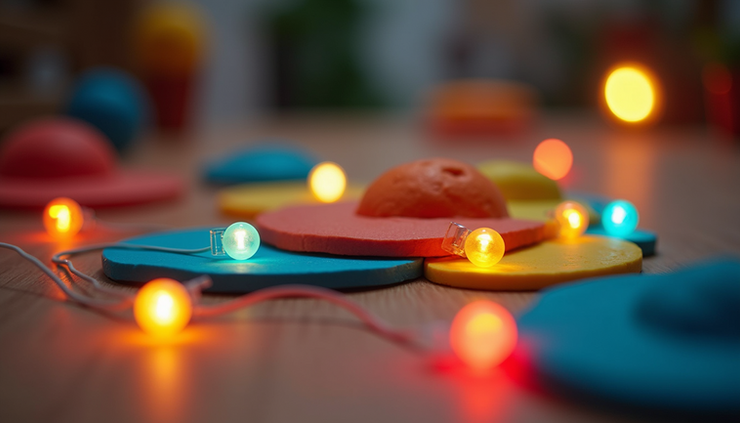
Electricity can be fascinating, and this experiment uses conductive and insulating play dough to build a working circuit. You’ll need:
Two types of play dough: one conductive (salt-based) and one insulating (sugar-based)
A small LED light
A 9-volt battery with connector wires
Steps:
Shape the conductive dough into two separate balls.
Connect each ball to one terminal of the battery using the wires.
Place the LED so its legs touch each dough ball.
Use the insulating dough to separate the conductive dough balls without breaking the circuit.
The LED should light up, showing how electricity flows through conductive materials but not insulators. This project introduces basic electronics and encourages kids to experiment with circuit design.
3. Make a Rainbow in a Jar with Density Layers
This experiment uses liquids of different densities to create a colorful layered effect. It’s a great way to explore the concept of density and how substances stack without mixing.
Materials:
Honey
Corn syrup
Dish soap (colored if possible)
Water (colored with food coloring)
Vegetable oil
Rubbing alcohol (colored with food coloring)
A tall, clear glass or jar
Instructions:
Slowly pour each liquid into the jar in the order listed, starting with honey at the bottom.
Pour gently down the side of the jar or over the back of a spoon to avoid mixing.
Watch as the liquids form distinct layers, creating a rainbow effect.
This visual experiment helps kids understand why some liquids float on others and introduces the idea of density in a colorful way.
4. Explore Static Electricity with a Balloon and Paper
Static electricity is easy to demonstrate and always surprises kids. This simple activity requires a balloon and small pieces of paper.
Inflate a balloon and tie it off.
Rub the balloon on your hair or a wool sweater for about 30 seconds.
Hold the balloon near tiny paper bits on a table or floor.
Watch the paper jump up and stick to the balloon.
This happens because rubbing transfers electrons, creating static charge. It’s a fun way to introduce electric charges and forces without any special equipment.
5. Grow Crystals Using Salt or Sugar
Crystal growing is a slow but rewarding experiment that shows how solids form from solutions. You can use salt or sugar to create sparkling crystals on a string or stick.
What you need:
A jar or glass
Hot water
Salt or sugar
A spoon
A piece of string or a wooden stick
Steps:
Heat water until very warm (adult supervision required).
Stir in salt or sugar until no more dissolves (creating a saturated solution).
Tie the string to a pencil and rest the pencil across the jar’s opening so the string hangs inside.
Leave the jar undisturbed in a cool place.
Crystals will start forming on the string after a few days.
This experiment teaches about solubility and crystal formation, encouraging patience and observation.


Comments